Check valve
## Copyright © EDF 2002 - 2026
## ThermoSysPro Version 4.2
This component model is documented in Sect. 13.11 of the ThermoSysPro book.
# Check valve
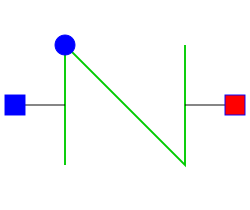
Check valves are used in pipes to prevent backflow for safety reasons.
They feature a clapper that opens on direct flow and closes on backflow.
This component is similar to the [switch valve](modelica://ThermoSysPro.WaterSteam.PressureLosses.SwitchValve).
The difference lies in the control: the switch valve position is set by an actuator, whereas the check valve is operated by the pressure difference between the inlet and the outlet.
The check valve thus operates automatically, without external control.
Following assumptions are made:
- The movement of the clapper between the open and close positions is instantaneous, so that its inertia is neglected.
## Modelica component model
The equations mentioned below are implemented in the component *CheckValve*, located in the *WaterSteam.PressureLosses* sub-library.
This component has 2 connectors:
- C1: fluid inlet,
- C2: fluid outlet.

## Nomenclature
| Symbol| Description| Unit| Definition| Modelica name |
| :---------------------------- | :---------------------------------------------------------- | :------------------------------- | :-------------------------------- | :----------- |
| \\(h\\)| Fluid specific enthalpy | \\(\mathrm{J} / \mathrm{kg}\\)|| h |
| \\(m\\)| Fluid mass flow rate| \\(\mathrm{kg} / \mathrm{s}\\)|| Q |
| \\(P\_{\mathrm{i}}\\)| Fluid pressure at the inlet| \\(\mathrm{Pa}\\)|| C1.P |
| \\(P\_{\mathrm{o}}\\)| Fluid pressure at the outlet| \\(\mathrm{Pa}\\)|| C2.P |
| \\(\Delta P\\)| Pressure loss of the fluid between the inlet and the outlet | \\(\mathrm{Pa}\\)| \\(P\_{\mathrm{i}}-P\_{\mathrm{o}}\\) | deltaP |
| \\(\Delta P\_{\text {close }}\\) | Pressure difference when the valve closes | \\(\mathrm{Pa}\\)|| dPFerme |
| \\(\Delta P\_{\text {open }}\\)| Pressure difference when the valve opens | \\(\mathrm{Pa}\\)|| dPOuvert |
| \\(\Lambda\\)| Friction pressure loss coefficient| \\(\mathrm{m}^{-4}\\)|| k |
| \\(\rho\\)| Fluid density| \\(\mathrm{kg} / \mathrm{m}^{3}\\) || rho |
## Governing equations
The model is based on a simple pressure loss equation when the valve is open.
When the valve closes, it dynamically switches to the zero-flow equation.
### Static momentum balance equation
- Validity domain:
\\(\forall \dot{m}\\)
- Mathematical formulation:
$$ \left\{\begin{array}{l}\dot{m} =0 \; \text{ if } \; \Delta P<\Delta P_{\text{close}}\\ \Delta P=\Lambda \cdot \frac{\dot{m} \cdot \lvert \dot{m} \rvert }{2 \cdot \rho} \; \text{if} \; \Delta P > \Delta P_{\text{open}} \end{array} \right.$$
- Comments:
The valve closes when \\(\Delta P\\) drops below \\(\Delta P\_{\text {close }}\\) and opens when \\(\Delta P\\) rises
above \\(\Delta P\_{\text {open}}\\).
To avoid chattering, \\(\Delta P\_{\text {open }}\\) and \\(\Delta P\_{\text {close }}\\) should be set such that \\(\Delta P\_{\text {close }}<\Delta P\_{\text {open }}\\).
## References
El Hefni, Baligh and Bouskela, Daniel (2019). [Modeling and Simulation of Thermal Power Plants with ThermoSysPro](https://link.springer.com/book/10.1007/978-3-030-05105-1), sect. 13.1. Springer Nature Switzerland AG.
Author Daniel Bouskela
Generated at 2026-08-05T20:24:29Z by OpenModelicaOpenModelica 1.27.0 using
GenerateDoc.mos
 .ThermoSysPro.WaterSteam.PressureLosses.CheckValve